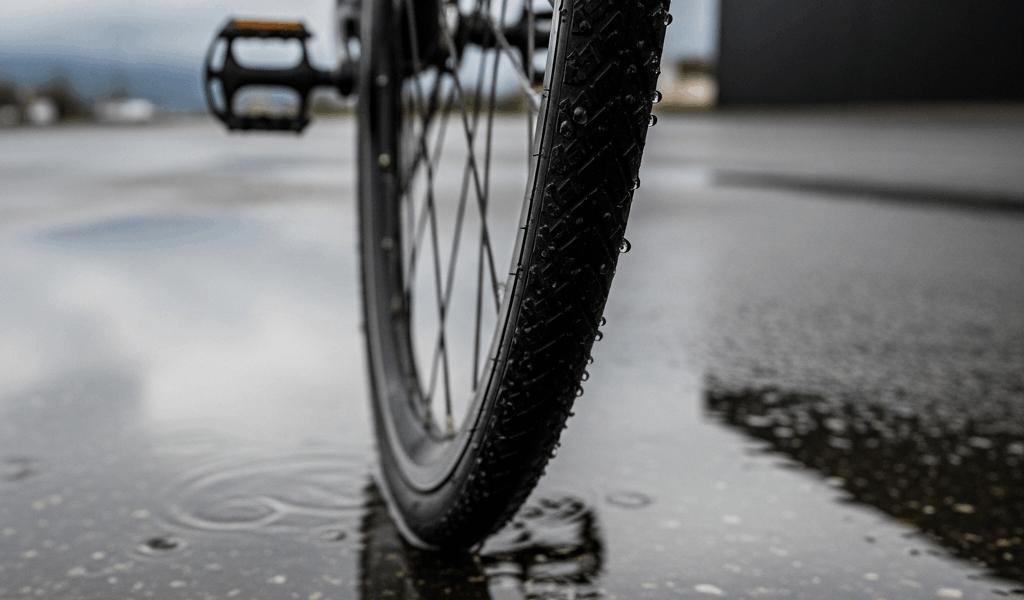
Why Rain Rides Go Wrong So Quickly
Cycling in the rain has gotten complicated with all the conflicting advice flying around. Some people swear it’s no big deal. Others treat it like a survival expedition. The truth lands somewhere in the middle — at least if you’ve actually done it enough times to know what goes wrong and when.
I spent three years ignoring rain forecasts before it caught up with me. Badly. The problems don’t arrive one at a time. Rim brakes lose roughly 30% of their stopping power the moment water sits between pad and metal. Disc brakes handle it better, but they’re not magic either. Tire contact patches hydroplane on standing water, grip just vanishes mid-corner, and suddenly you’re negotiating with physics at 22 mph. Meanwhile your chamois soaks through, and by mile seven you’re not just wet — you’re chafed raw and done. These failures stack. That’s what makes wet riding genuinely dangerous for riders who haven’t figured out the system yet.
Braking on Wet Roads Without Wiping Out
Probably should have opened with this section, honestly. Wet braking is where rain rides turn dangerous the fastest — and it’s the piece most riders underestimate until they feel that spongy lever pull approaching a red light.
The core problem with rim brakes: water pools between the pad and the braking surface. You squeeze the lever. Nothing happens immediately. By the time friction burns through that water layer, you’ve burned through stopping distance you didn’t have. I’ve been in that exact situation. It’s not a gradual realization. It’s immediate dread.
The rule I run with now is a simple mental adjustment — add two full seconds to every stopping estimate. Dry conditions, 20 mph, maybe 1.5 seconds to a clean stop. Rain? Budget 3.5 seconds minimum. If a light changes and you’re rolling into an intersection, that gap matters enormously. Adjust your entry speed before you need the brakes, not during.
Disc brakes skip the water-pad interference problem, but wet rotors still take longer to bite than dry ones. The difference is measurable. Not guesswork.
Here’s a technique that genuinely works on descents: feather your brakes before the steep section starts. Short, light, repeated touches create friction that dries the rim surface without building heat. Ten to fifteen seconds of this and rim brakes recover maybe 60% of their dry stopping power. Not ideal. Adequate.
Corner entry speed is probably the single biggest lever you have. I take a familiar stretch of suburban turns at 18–20 mph on dry days. Rain drops that to 12–14 mph. That 30% reduction costs almost nothing on a commute or training loop and eliminates the front-wheel slip that ends with asphalt on your collarbone. Don’t ask your tires to handle braking and cornering grip simultaneously. Pick one.
Staying Visible and Keeping Your Vision Clear
Two separate problems. Same section because they’re both about seeing and being seen — and ignoring either one gets you into trouble fast.
Visibility first. Your rear light needs to be running. Always. Not blinking — solid, 50 lumens minimum. Rain shrinks your visual footprint dramatically. Wet windshields, struggling wipers, gray-on-gray contrast between you and the road — drivers miss cyclists in these conditions more than any other. A solid rear light cutting through that gray light is the difference between being noticed early and being a close call. I use a Cygolite Hotshot Pro, around $60, because it’s bright enough that drivers register it before they question whether it’s a reflection. Reflective vests and arm bands help, but less than most people assume. The light does the actual work.
Vision clarity is the second piece. Eyewear fogs almost immediately in rain — cold rain hitting a warm face creates condensation on the inside of your lenses inside 30 seconds. Dark lenses make this worse and reduce the ambient light you already can’t afford to lose. Clear or yellow lenses are the move. Yellow cuts haze and sharpens contrast on overcast days in ways that feel almost artificial until you try it.
Two solutions that actually address fogging:
- Anti-fog wipes. Zeiss makes them, around $8 a pack. Wipe your lenses before you roll out. Good for 20–30 minutes of wet conditions before you need to reapply. Simple, cheap, works.
- Lens vents. Most cycling glasses have small vents along the top and bottom edge. Open them. Airflow disrupts the temperature difference that causes fogging in the first place. Not obvious, but surprisingly effective.
In heavy downpours, I skip glasses entirely and ride with a vented helmet visor. My Bell Stratus — around $90 — has a short visor that blocks direct rain without any fogging trade-off. The downside: no correction for prescription wearers. If you need Rx lenses, anti-fog prescription inserts for cycling glasses exist, though they run $40 and up. The easier solution, honestly: swap to contacts on wet ride days, or accept that you’re stopping every few miles to wipe lenses manually.
Clothing and Comfort Fixes That Actually Work
Chafing in wet conditions is brutal in a way that dry-ride chafing isn’t. Your chamois is engineered to wick moisture and compress evenly under load. Soaked through, it loses that compression and starts shifting with every pedal stroke. Ninety minutes of that friction and your skin pays for it for three days. The fix is simple: chamois cream, double what you’d use on a dry ride. A 2.5 oz tube normally lasts me five rides. In rain it lasts two, maybe three. Apply to both the shorts and your skin. The cream builds a moisture barrier that survives a full soak better than anything else I’ve tried.
Arm warmers solve a problem I didn’t anticipate until I felt it — the gap between sleeve end and glove cuff becomes a direct water channel running straight down your inner arm and into your core. That gap is small. The heat loss isn’t. Generic arm warmers in the $12–$20 range cover it completely and trap enough of a warm air layer that your arms stay functional even soaked. Sounds like a minor thing. Isn’t.
Overshoes aren’t about keeping your feet dry — your feet will get wet regardless, full stop. They’re about keeping your feet warm enough to function at mile 40 when the temperature drops and you’re still an hour from home. Merino wool base socks underneath make a real difference here. Merino maintains insulation when saturated. Cotton and synthetics lose insulating value almost immediately when wet. Yes, neon yellow jersey plus wool socks plus neoprene overshoes is a look. You’ll be warm though.
Post-Ride Bike Care to Avoid Wet Ride Damage
You made it back. Now your drivetrain is saturated, your cables are holding water, and every moving part is a rust and grime problem waiting to develop. Skip the post-ride cleanup and your shifting gets sluggish by the next ride. Your brake pads embed grit. Your chain corrodes faster than you’d think possible.
The checklist takes ten minutes. That’s it.
- Dry the chain with an old towel — side plates and rollers, not just a quick wipe across the top.
- Lube the chain immediately after drying. A single day sitting damp in a garage and corrosion starts. Finish Line Dry lube works well in wet conditions and doesn’t wash off as aggressively as oil-based options.
- Check brake pads for embedded grit. Spin each wheel and look at the pad contact surface. Grit embedded in pad material accelerates wear and can score your rims over time. Wipe them down if they’re dirty.
- Inspect the rims while the wheels are still spinning. Mud and gravel pack into brake zones and quietly reduce braking performance until you notice it mid-descent.
Wipe the frame and seatpost dry with a rag — particularly around any areas where water pools. Store the bike somewhere dry. Not climate-controlled, just not outside in humidity. Coastal riders dealing with salt air should be more aggressive about this. Salt accelerates everything.
Wet rides are manageable if you run the full system: visibility sorted, braking speeds adjusted, clothing layered for extended wetness, bike cleaned afterward. Miss one piece and the others cover less than you’d hope. Run all four and rain stops being a reason to stay home.


Stay in the loop
Get the latest cyclingfan.org updates delivered to your inbox.