What Happened to Lance Armstrong? The Biopic, the Ban, and What He Does Now
If you’ve typed “what happened to Lance Armstrong now” into a search engine recently, you’re not alone — and honestly, the answer is a lot more interesting than you’d expect from someone the sports world largely wrote off a decade ago. Armstrong is 53 years old, living in Austin, Texas, still deeply embedded in professional cycling, hosting one of the most listened-to cycling podcasts on the planet, backing a new American pro team, and — maybe most remarkably — about to be the subject of a major Hollywood biopic starring Austin Butler. The story didn’t end with the ban. Not even close.
The Final Chapters of His Racing Career
For anyone who needs the compressed version: Lance Armstrong won the Tour de France seven consecutive times between 1999 and 2005. He retired in 2005, came back in 2009 and 2010, then retired again. In 2012, the United States Anti-Doping Agency (USADA) released a 1,000-page report describing what it called “the most sophisticated, professionalized and successful doping program that sport has ever seen.” Armstrong was stripped of all seven Tour titles and received a lifetime ban from sanctioned competition.
In January 2013, he sat across from Oprah Winfrey and admitted to using EPO, blood transfusions, testosterone, and human growth hormone throughout much of his career. That interview — watched by roughly 28 million people across two nights — was, depending on your perspective, either a carefully managed PR exercise or a genuinely painful public reckoning. Probably both.
The UCI, cycling’s world governing body, declined to reinstate him in 2015 after a review. The $100 million lawsuit from the U.S. Department of Justice, which alleged Armstrong defrauded the federal government by doping while sponsored by the U.S. Postal Service, was settled in 2018 for $5 million — a fraction of what prosecutors originally sought, but still a significant financial and legal resolution. He also settled multiple civil suits with former teammates and sponsors over the years, most famously paying $11.9 million to SCA Promotions, a company that had tried to withhold a $5 million bonus.
That’s the recap. Heavy, yes. But here’s what almost nobody covers in depth — what came after all of it.
The Move Podcast and Commentary Career
Stripped of titles, barred from competition, and staring down a reputational crater the size of a small country, Armstrong did something genuinely smart. He started talking about cycling again — not defensively, not as a form of rehabilitation theater, but with the kind of deep tactical knowledge that you simply cannot fake after riding at the highest levels of the sport for two decades.
The Move launched in 2017 during the Tour de France. The format is deceptively simple: Armstrong and his longtime co-host Johan Bruyneel — yes, that Johan Bruyneel, his former team director at U.S. Postal and Discovery Channel, who himself received a lifetime ban from the sport — break down each stage of the Tour de France in real time. Day by day. Stage by stage. Climb by climb.
I started listening during the 2019 Tour because a friend who races Cat 3 crits in Colorado wouldn’t stop talking about it. Within about three episodes I understood why. The level of tactical detail is extraordinary. Armstrong will describe a hairpin descent and tell you exactly which line a GC rider should take, why a breakaway was allowed to go at the 47-kilometer mark on a specific stage, and what the directeur sportif was almost certainly saying over the radio. You don’t get that on most broadcast commentary.
Bruyneel’s involvement is worth noting. He was banned by the Court of Arbitration for Sport in 2014 — a 10-year ban that was extended on appeal. His lifetime ban came later. He and Armstrong co-hosting together raises eyebrows in certain corners of the cycling community, but the podcast’s audience has grown regardless. The show does not exclusively cover the Tour; they’ve expanded to cover the Vuelta a España, Paris-Roubaix, and other major races throughout the season.
Armstrong has also appeared as a guest commentator on various platforms, been interviewed for cycling documentaries, and has grown a significant presence on social media where he regularly comments on races in progress. His Instagram, as of 2024, sits around 3.5 million followers. The audience is real. The engagement is real. He rebuilt a media presence almost entirely from scratch.
Team Sponsorship — Modern Adventure with The Move
Probably should have opened with this section, honestly, because it’s the most surprising development for people who assumed Armstrong was effectively exiled from professional cycling for life.
In 2023, Armstrong announced that The Move — his podcast brand — would become a co-title sponsor of a professional cycling team. The team in question competes at the UCI ProTeam level, the second tier of professional cycling, one step below the WorldTour. The partnership with Modern Adventure (a travel and adventure company based in San Francisco, priced at the $5,000-to-$25,000-per-trip end of the luxury adventure tourism market) created a co-title sponsorship arrangement: the team became known as The Move–Modern Adventure.
Here’s the part that confuses people and requires some explanation. Armstrong’s lifetime ban is specifically a ban from participating in — or working with — events and organizations under USADA and WADA jurisdiction. In the United States, that covers sanctioned competition. But the ban does not prohibit him from being a team sponsor or a business investor. Sponsorship is a commercial relationship. It’s not the same as serving as a directeur sportif, a manager, or a coach in an official capacity within a UCI-licensed team’s staff structure.
The UCI and WADA have rules about banned individuals working in official team management roles. Armstrong’s involvement as a sponsor — essentially as a brand partner lending the name and reach of The Move podcast to the team — sits outside that specific prohibition. It’s a meaningful distinction. He’s not calling climbs from the team car. He’s on the title banner.
The team has used the sponsorship to gain visibility in the American cycling market, which desperately needs it. Having Armstrong’s name attached — polarizing as it is — generates media coverage that a mid-level ProTeam would never otherwise receive. Whether you find that appropriate or cynical depends entirely on where you stand on the man himself.
Dragged back into the headlines by the team announcement, Armstrong gave several interviews discussing what he hopes to contribute to American cycling’s development pipeline. He speaks about it with what sounds like genuine investment. Whether that’s enough to matter is a separate question.
The Austin Butler Biopic Coming in 2026
In early 2024, it was confirmed that a major biographical film about Lance Armstrong is in active development, with Austin Butler attached to play Armstrong. If you’ve seen Butler’s work in Elvis (2022) — where he received an Academy Award nomination for Best Actor — you understand why this casting generated immediate attention. Butler is not a safe, conventional pick. He’s an actor who commits completely and physically to roles in a way that not many people in his generation do.
The film is being directed by Edward Berger, the German filmmaker who directed All Quiet on the Western Front (2022), which won four Academy Awards including Best International Feature Film and Best Cinematography. That’s a significant creative pedigree. This is not a made-for-streaming quickie. The script is being written by Zach Baylin, who wrote King Richard (2021), the film about Richard Williams and the tennis upbringing of Venus and Serena Williams. Baylin has a demonstrated ability to handle the complexity of a real sports figure’s life without flattening them into either hero or villain.
The combination of Berger and Baylin suggests the film is not going to be a simple redemption story or a straightforward takedown piece. The source material is genuinely complicated — the cancer survival narrative, the humanitarian work through Livestrong (which he officially resigned from in 2012 but which continues to operate and has helped raise more than $500 million for cancer resources), the doping, the lawsuits, the Oprah confession, and now this strange second act as a media personality and sponsor.
A 2026 release window has been discussed, though no official date has been locked in as of this writing. Armstrong has spoken publicly about the biopic in interviews, saying he has been cooperative with the production. He’s expressed that he wants the film to be honest. Take that for what you will.
Is Lance Armstrong Still Banned From Cycling?
Yes. The lifetime ban is still fully in place. There has been no reinstatement, no formal appeal in progress, and no indication from USADA or WADA that circumstances have changed.
What the ban actually covers is worth spelling out precisely, because this is where I initially got confused when researching the team sponsorship story. The ban prohibits Armstrong from:
- Competing in any sport governed by a signatory to the World Anti-Doping Code
- Serving in official capacities — coaching, management, medical support, and similar roles — within those sanctioned sports
- Receiving funding from organizations subject to WADA code compliance
The ban does not prohibit him from:
- Being a commercial sponsor of a team
- Owning a media company that covers cycling
- Appearing on podcasts, broadcasts, or streaming platforms as a commentator or analyst
- Attending races as a spectator
- Running, cycling, or participating in non-sanctioned events (he’s completed the Leadville Trail 100 MTB multiple times, a race not governed by USADA)
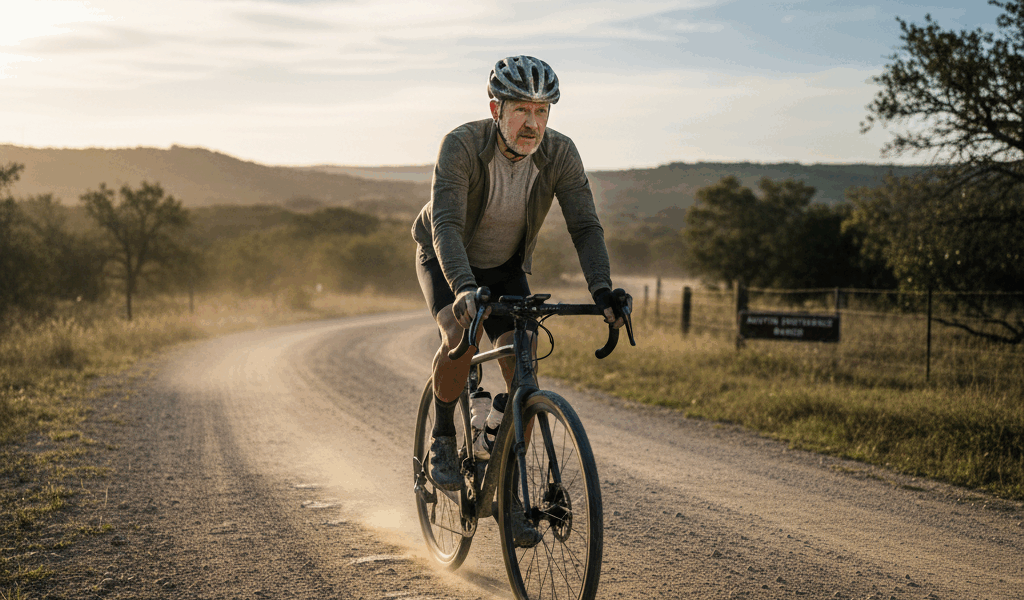
He has completed multiple non-sanctioned ultramarathons and gravel rides. He finished the 2023 Unbound Gravel 200 — a 200-mile gravel race in Kansas — and was openly competitive about his finish time. The Unbound is not a WADA-sanctioned event. He can race it. He does race it.
This is the strange reality of where Armstrong sits in 2025. Banned from the highest levels of professional cycling in any official capacity, yes. But active, visible, influential, and apparently impossible to fully push out of the sport he dominated and damaged in equal measure.
The biopic arriving in 2026 will almost certainly reignite every argument about whether he deserves a platform, whether cycling’s doping era should be understood differently given how widespread it was, and whether his cancer advocacy counts for anything in the moral ledger. Those arguments were never fully resolved. They were just paused.
He is still here. Still talking. Still sponsoring. Still finishing 200-mile gravel races in the Kansas heat. Whatever you think of Lance Armstrong, the story isn’t over yet — and if the Austin Butler casting is any indication, the most dramatic chapter might still be in production.



Stay in the loop
Get the latest cyclingfan.org updates delivered to your inbox.