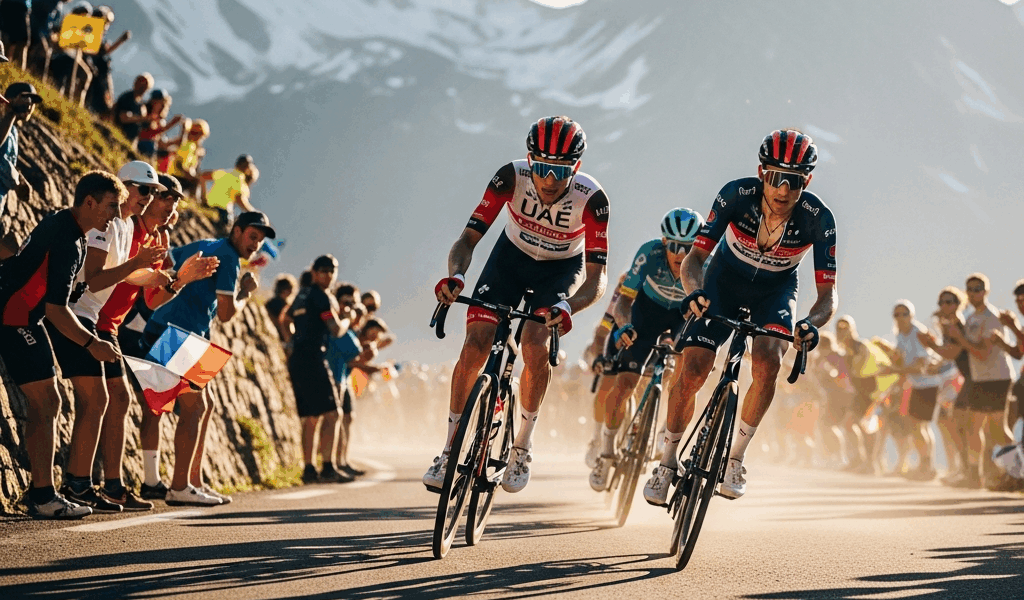
Tour de France 2026 Favorites — Who Can Stop Tadej Pogacar?
Tour de France 2026 has gotten complicated with all the speculation flying around. But every serious conversation still starts in the same place: Tadej Pogacar. That’s just cycling’s reality right now. As someone who’s followed the Tour obsessively since 2010 and watched every single stage since 2018, I learned everything there is to know about what genuine dominance looks like in a three-week race — and what we saw in 2024 wasn’t a bike race so much as a coronation with an extremely expensive supporting cast. So when I try to project 2026, the honest starting point isn’t “who are the contenders?” It’s the harder question: what would actually need to go wrong for Pogacar to lose?
This is fan analysis, not a press release. I’ll give you my genuine read on the four or five riders who actually matter, what the route might mean for each of them, and then commit to a real prediction at the end — not some cowardly “it could go either way” hedge. Let’s get into it.
Why Pogacar Is the Overwhelming Favorite
Let’s just put the numbers on the table. In 2024, Pogacar won the Tour de France by over six minutes. Six minutes. In modern Tour racing — where races get decided by thirty seconds and teams spend four years designing aero helmets to save two watts — six minutes is a geological epoch. He won six stages including the individual time trial and multiple mountain finishes. He attacked on climbs where other GC riders were just trying to survive.
Stunned by that margin, I went back and rewatched the Col de la Couillole stage about four times. What struck me wasn’t just the pace — it was the timing. He accelerated when Vingegaard was already at his limit, riding a Colnago V4Rs with a 36-tooth chainring he’d apparently had recut specifically for that gradient. No panic. No visible calculation. Just this almost bored-looking surge that shredded the front group like it was a sprint stage peloton. That kind of race-reading doesn’t come from training data. It’s instinct — and Pogacar has more of it than anyone in the peloton right now.
His team situation at UAE Team Emirates is worth examining seriously too. In 2026 he’ll likely still have Adam Yates, João Almeida, and Marc Soler available as mountain domestiques. Almeida is a genuine Grand Tour contender in his own right — having him ride in service of Pogacar is roughly equivalent to hiring a Michelin-starred chef to make you a cheese sandwich. The depth is absurd.
What would need to change for him to lose? A few things. He could crash — it happened at the 2023 Vuelta and he still won, but a bad Tour crash is different. There’s the illness scenario — COVID took him out of the 2024 Giro mid-race, though he’d already won it by then. Or, most realistically, Vingegaard shows up at a level we haven’t seen since 2023 and the route tilts toward a time trial-heavy parcours. None of these are impossible. None are things you can count on.
His One Weakness — If You Can Even Call It That
Pogacar is slightly more vulnerable in very long, sustained time trials compared to pure TT specialists. He’s not weak — but a 50-kilometer flat TT against Remco Evenepoel at full fitness isn’t a guaranteed Pogacar win. If the 2026 route includes one of those, the margins tighten. Slightly. Probably still his race.
Jonas Vingegaard — The Only Proven Challenger
Probably should have opened with this section, honestly, because Vingegaard is the one variable that changes the entire race calculus.
Let’s be real about where he was in April 2024: in a hospital bed with broken ribs, a collapsed lung, and a clavicle fracture after a horrific crash at the Volta a Catalunya. The fact that he made it to the Tour start at all was remarkable. The fact that he finished second — still over six minutes back, yes, but second at the Tour de France after that kind of trauma — tells you something important about the man.
Here’s what I got wrong publicly in my 2024 predictions: I thought Vingegaard wouldn’t recover his top-end power in time for July. I said it in a forum post somewhere around May 2024, and I was half-right. He recovered enough to race. He didn’t recover enough to actually challenge Pogacar. Don’t make my mistake — that distinction matters enormously for 2026, because we’re now looking at a Jonas who has had a full recovery window. A full winter. A full spring campaign with no crash hangover.
If he comes into 2026 the way he was in 2023 — matching Pogacar move for move, those two-man battles on hors-catégorie climbs feeling like watching two completely different species race — then this becomes a genuinely open race.
Visma-Lease a Bike remains the best-organized Grand Tour team in the world outside of UAE. Their preparation is meticulous in a way that borders on obsessive. They reportedly spent weeks in 2023 training on specific Tour climbs using Wahoo ELEMNT Bolt computers to map every gradient change, altitude-camping at Livigno in between. They calibrate their domestiques’ form specifically for July — riders like Wilco Kelderman and Matteo Jorgenson arrive at the Tour already peaked. That organizational machine doesn’t disappear just because Pogacar is dominant.
The mountain question for Vingegaard in 2026 is this: can he match Pogacar on pure steep gradient climbs, or does he only keep pace on the longer, more sustained ascents? In 2023 it looked like the former. In 2024 it looked like neither. We need 2025 race data — particularly his Critérium du Dauphiné and Tour de Suisse results — before making a real call here.
The Head-to-Head History
Vingegaard beat Pogacar in 2022. Vingegaard beat Pogacar in 2023. Pogacar beat a still-recovering Vingegaard in 2024. The head-to-head, when both riders are genuinely healthy, is actually closer to even than last year’s result implies. That’s the real case for taking Vingegaard seriously as a 2026 contender — not wishful thinking, but actual historical precedent from two vintage Tours.
Remco Evenepoel — Third Force or Dark Horse?
But what is Remco Evenepoel’s ceiling at the Tour de France? In essence, he’s one of the most complete cyclists in a generation. But it’s much more than that — he’s an Olympic time trial champion, a Vuelta winner, a former road World Champion — at 26 years old by the time the 2026 Tour rolls around, approaching his absolute physical peak. And yet I keep coming back to this: he has not cracked the top two at the Tour de France.
His 2024 Tour was genuinely impressive in context. He finished third. He held his own in the mountains better than most people expected — his time trialing was predictably excellent. But the gap to Pogacar was still nearly nine minutes, and the gap to a compromised Vingegaard was still over three. That’s not a knock on Evenepoel. That’s just what the current hierarchy looks like.
The argument for him in 2026 hinges on a few things. His team, Soudal Quick-Step, has been rebuilding its support structure around his Grand Tour ambitions — Patrick Lefevere’s squad has historically been better at one-week races and classics than three-week GC battles, but they’ve brought in riders capable of working deep into mountain stages. The 2026 roster construction around Evenepoel will matter enormously.
His ceiling at the Tour is probably a podium — maybe second place if Vingegaard has a bad day and the route tilts heavily toward time trials. His realistic floor is still top five. That’s not nothing. In a field without Pogacar or Vingegaard, Remco wins the Tour de France comfortably. In this field, he’s the third man in a race with a very clear top two.
The Mountain Problem — Still Not Resolved
Evenepoel loses time to both Pogacar and Vingegaard on very steep, punchy climbs. He’s noticeably better on longer, more regular gradients where he can sustain a high power output over 40 or 50 minutes. The 2026 route selection is going to matter more for his prospects than for either of the top two — probably the most route-dependent GC contender in the entire field.
The Route Factor — Does It Favor Climbers or Time Trialists?
As of early 2025, the official 2026 Tour de France route hasn’t dropped — ASO typically reveals it in October of the preceding year, so we’re working with informed speculation here. But the route shapes the race in ways significant enough to address now.
Recent editions have trended toward fewer flat stages and more mountain time. The 2024 route was essentially a climber’s paradise — multiple summit finishes, a relatively short ITT, almost no flat days where sprinters could dominate and GC riders recover quietly. If 2026 follows that template, it plays directly into Pogacar’s hands and makes Evenepoel’s path to the podium significantly harder.
A route with a long individual time trial — think 50 kilometers or more, flat or rolling terrain, something closer to the Prologue-heavy Tours of the 1990s — would compress the margins. Evenepoel would bank serious time. Vingegaard would bank some. Even Pogacar would benefit, but the others close the gap enough to matter.
Mountain finish locations matter too. The Pyrenees versus the Alps produce genuinely different races. Short brutal climbs like La Planche des Belles Filles punish certain riding styles. A stage finishing on Alpe d’Huez after 140 kilometers of rolling terrain produces a different outcome than a direct summit finish on something like Superdévoluy — two completely different races, essentially. ASO has been deliberately aggressive with route design in recent years, pushing for attacking races over tactical ones. That philosophy almost always helps Pogacar.
Key things to watch for when the 2026 route drops in October 2025: total ITT distance, whether there’s a mountain time trial, how many true summit finishes exist, and whether the final week concentrates the hardest climbing. Typically the race gets decided in the final Alpine week — and if that week includes three consecutive hard days without recovery, the advantage goes to whoever has the deepest team. That’s UAE Team Emirates.
Our Pick — Who Wins the 2026 Tour de France
Tadej Pogacar wins the 2026 Tour de France. There it is.
Here’s the actual case. Pogacar turns 27 in July 2026. Physiologically, male cyclists typically peak somewhere between 26 and 30 for Grand Tour performance — he is not declining. He’s potentially not even at his ceiling yet. He’s won the Tour in 2020, 2021, and 2024, came desperately close in 2022 and 2023 against a Vingegaard who was himself at an extraordinary level. His worst Tour finishes in the last five years are second place. Twice.
The only realistic path to a Pogacar loss in 2026 runs through a fully recovered Vingegaard having a perfect race, a route including at least 60 kilometers of individual time trialing across two stages, no crashes or illness for either man, and UAE having some kind of organizational collapse pulling their domestiques off the mountain at critical moments. All of those things can happen independently. None of them are likely to happen simultaneously.
My second-place prediction is Vingegaard — assuming full recovery. Not diplomacy, but genuine historical precedent. His 2022 and 2023 performances were at a level that could actually threaten Pogacar in the right conditions. A healthy Jonas, a team firing on all cylinders, a mountain-heavy route — that’s a race going to Stage 20 without a decision. I’ve been wrong about Vingegaard’s recovery timeline before. I’m not making that mistake twice.
Evenepoel takes third. He’s simply too talented to fall out of the top three, and his time trialing acts as a hard floor — he will bank time somewhere on a typical Tour route and fight to hold it in the mountains better than anyone else not named Pogacar or Vingegaard.
Beyond those three, keep an eye on Carlos Rodríguez of Ineos Grenadiers — quietly assembled a Grand Tour resumé that doesn’t get nearly enough attention — and Enric Mas at Movistar, frustratingly inconsistent but capable of podium finishes on the right day. Neither threatens the top two. Both are worth tracking for stage wins and top-five finishes.
That’s what makes this era endearing to us obsessive Tour fans — the brutal clarity of it. Barring disaster, we’re probably watching a Pogacar era that could rival anything the sport has seen. He’s already in the conversation with Merckx, Hinault, and Indurain in terms of sheer dominance. Two more years of this and that conversation becomes a lot less contested. If you’re watching 2026 hoping for a genuine thriller, your best scenario is a fully healthy Vingegaard — because he’s the only man who has actually made Pogacar hurt. Everyone else is racing for third.




Stay in the loop
Get the latest cyclingfan.org updates delivered to your inbox.