This article includes affiliate links. We may earn a commission at no extra cost to you.
25mm vs 28mm Road Bike Tires — The Upgrade That Changes Everything
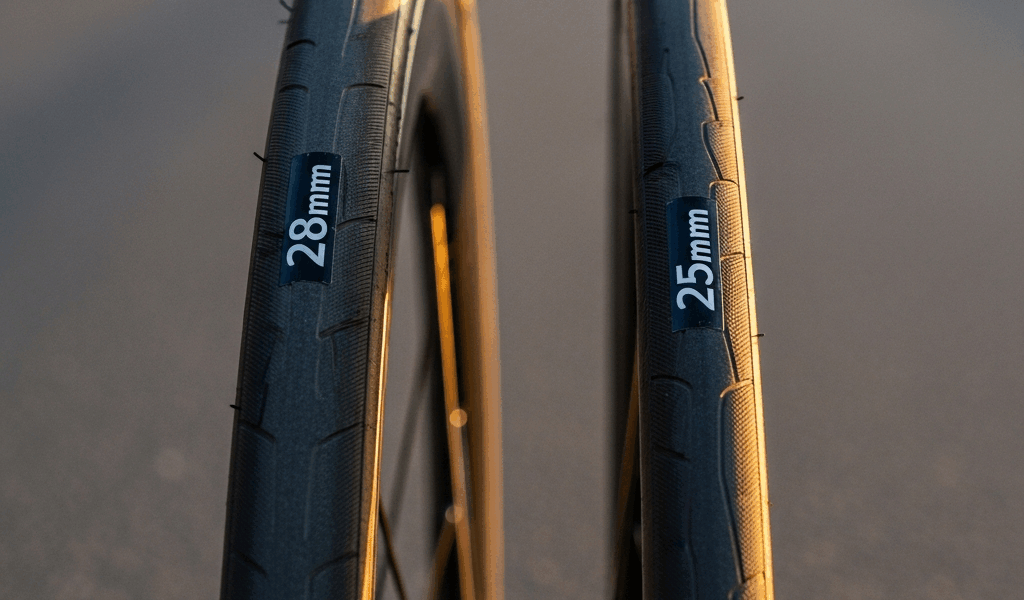
The 25mm vs 28mm road bike tire debate has gotten complicated with all the conflicting advice flying around — forums swearing by narrow and aero, coaches pushing wider and compliant, and everyone citing a different wind tunnel study to win an argument at the café stop. As someone who spent two full years riding Continental GP5000s in 25mm, convinced I was making the aerodynamically correct choice, I learned everything there is to know about why three millimeters matters more than it has any right to. A single 80-mile sportive in the rain near Yorkshire changed my thinking completely. Numb hands by mile 40. Lower back finished by mile 60. And somewhere on a rough B-road, I started doing the math on whether being “aero” was actually making me faster — or just making me more miserable.
I switched to 28mm. Haven’t looked back since.
What follows breaks down exactly what changes between those three millimeters, what the research actually says about speed, and — critically — whether your bike will even fit a wider tire before you spend £60 on a pair and find out the hard way.
25mm vs 28mm — The Specs That Matter
On paper, the difference looks almost insultingly small. Three millimeters. Less than an eighth of an inch. But that tiny change touches three things that show up on every single ride: rolling resistance, vibration absorption, and — counterintuitively — aerodynamic drag.
Rolling Resistance
But what is rolling resistance, exactly? In essence, it’s the energy lost each time your tire deforms against the road surface. But it’s much more than that — it’s the reason two tires with identical compounds can perform completely differently depending on pressure and width.
A narrower tire at higher pressure creates a long, thin contact patch. A wider tire at lower pressure creates a shorter, rounder one. That rounder shape deforms less aggressively with each wheel rotation — less deformation means less energy converted to heat, means less energy wasted. This is the core mechanical argument for wider tires, and it holds up under real testing.
Running 25mm GP5000s, I was inflating to around 100 PSI front, 105 rear — basically what the sidewall and a generic online calculator told me to do. On 28mm, the recommended range for my weight (around 78kg) drops to roughly 80–90 PSI. That lower pressure is not a compromise. It is the entire point.
Aerodynamic Drag
This is where most cyclists get it badly wrong. The received wisdom for years — honestly, for decades — was that narrower equals faster because less frontal area equals less drag. That logic made sense. It was also incomplete.
The aerodynamic variable that actually matters is the relationship between your rim width and your tire width. Modern road bike rims, anything built in the last five years with a wider internal profile, are designed to work best with a tire that sits slightly wider than the rim itself. Running a tire narrower than the rim creates turbulence at the shoulder where air transitions from rim to rubber. Running a tire that matches or slightly exceeds rim width produces a smoother, cleaner airfoil shape.
Most current endurance and race rims have internal widths of 19–21mm. On those rims, a 28mm tire produces measurably better aerodynamics than a 25mm tire. Zipp, Enve, and Hunt have all published wind tunnel data confirming exactly this. It’s not controversial among engineers anymore — it still is among club riders on Saturday morning, which is fine. Debate is half the fun.
That’s what makes the wider tire argument endearing to us road cyclists — it managed to be both the faster and the more comfortable choice simultaneously, which almost never happens.
Comfort Difference You Can Actually Feel
Probably should have opened with this section, honestly — because for most riders, comfort is the real reason to switch, and the effect is immediate.
Frustrated by a particularly nasty cattle grid on a training ride last March, I nearly lost the front end of my bike on 25mm tires at 100 PSI. Same road on 28mm at 85 PSI — I felt it, the bike shuddered slightly, but it tracked through cleanly. Enough air volume to absorb the sharp edge rather than transfer it straight into my wrists and up through the stem.
More air volume at lower pressure acts like a compliant suspension layer. The tire deforms around road imperfections instead of bouncing off them — and over long distances, that difference accumulates into something you absolutely feel in your body.
Fatigue — The Hidden Performance Factor
Energy spent absorbing road vibration through your hands, arms, and core is energy not going into the pedals. Sounds abstract until you do a 100-mile ride on rough roads and notice your legs feel completely fine while your upper body is wrecked. That was my exact experience at a 2022 sportive near Skipton — legs good, triceps surprisingly destroyed, lower back sending strongly-worded complaints by mile 85.
Don’t make my mistake. A pressure drop of 15–20 PSI on 28mm cuts that vibration transmission significantly. Not eliminated — you still know what surface you’re riding — but the punishing high-frequency chatter that quietly stacks up into fatigue over three or four hours gets removed from the equation.
Lower pressure also improves grip in corners and in the wet. Not marginal improvement. The difference between confidence and genuine anxiety on a wet descent — that’s the actual gap.
Speed — Are 28mm Tires Actually Slower?
No. And the evidence isn’t particularly close anymore.
The most thorough independent testing comes from the team at BicycleRollingResistance.com, which has tested hundreds of tire models under controlled lab conditions. Across nearly every quality tire in their database, the 28mm version of the same model rolls faster than the 25mm version — when both are inflated to an appropriate pressure for rider weight. The GP5000 in 28mm at 80 PSI beats the GP5000 in 25mm at 100 PSI in rolling resistance. Not by a huge margin, we’re talking watts rather than minutes, but the wider tire is faster. Not slower.
The Tour de France peloton has shifted, apparently rather decisively. In 2018, 25mm was standard across most teams. By 2023, 28mm was common and some riders were on 30mm — UAE Team Emirates, Jumbo-Visma, teams with full wind tunnel access and absolutely zero interest in going slower. That shift matters more than any forum argument.
The Pressure Piece People Miss
The single biggest mistake I made when first trying 28mm tires was inflating them to the same pressure I used on 25mm. Completely defeated the purpose. The wider tire needs lower pressure to achieve the correct contact patch geometry — running a 28mm at 100 PSI produces worse rolling resistance than a 25mm at the same pressure and a brutal ride quality on top of it.
Silca’s pressure calculator might be the best option here, as getting the right contact patch requires dialing in several variables simultaneously. That is because the correct pressure depends on rider weight, tire width, rim type, and terrain — not just what’s printed on the sidewall. It’s free online. Spend five minutes with it before your first ride on new tires.
Will 28mm Fit My Bike?
The practical question — and the one to answer before ordering anything.
Frame Clearance
Most road bikes manufactured after 2018 fit a 28mm tire without issue. Endurance-oriented frames — the Trek Domane, Specialized Roubaix, Giant Defy, Cannondale Synapse — are typically factory-specced with 28mm or larger and often accommodate 32mm. The clearance question gets harder with older race-geometry bikes and certain European frames built to tighter tolerances.
The check itself is simple. Remove your current tire. Measure the gap between the mounted tire and the nearest frame contact point — usually the chainstay or fork crown. First, you should confirm at least 3–4mm of clearance on each side — at least if you want to avoid the tire rubbing under load or after a hard sprint flexes the frame slightly. A 28mm tire, once mounted and inflated on a modern rim, typically measures 29–30mm due to the rim’s internal width pushing the casing outward. Factor that in before assuming you’re fine.
Brake Clearance
Disc brakes — almost never a clearance problem. The rotor sits inboard, the caliper doesn’t interact with the tire at all. Rim brakes are a different question. Dual-pivot calipers or direct-mount systems need arms that open wide enough to pass a 28mm tire through for removal and installation. Most modern rim brake calipers have a quick-release lever that handles this. Older or lower-spec calipers occasionally don’t. Check before buying.
My own bike is a 2020 Specialized Allez Sprint with direct-mount rim brakes — it fits 28mm, just. About 3.5mm of clearance at the chainstay on each side. I checked with a printed tape measure before ordering, which felt overly cautious right up until it turned out to actually matter.
What If Your Bike Doesn’t Fit 28mm
Run the widest quality 25mm tire you can find. A high-quality 25mm at appropriate pressure still beats a worn-out or cheap 28mm tire — the tire quality matters as much as the width. The GP5000 25mm, Pirelli P Zero Race 25mm, and Vittoria Corsa Pro 25mm are all excellent options. But if your frame clears 28mm, use it.
This new idea — that wider tires could be simultaneously faster, more comfortable, and more aerodynamic — took off several years later and eventually evolved into the mainstream consensus road cyclists know and argue about today. Three millimeters changed how I train, how I feel after long rides, and genuinely how much I enjoy cycling. That sounds like an overstatement. Ride 28mm for a month and come back to me.




Stay in the loop
Get the latest cyclingfan.org updates delivered to your inbox.